
Geodatendienst

CASE Outcrop Data (WMS)

Beschreibung

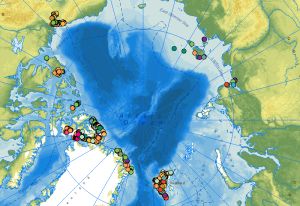
The web service of the dataset comprises the locations of outcrops with respective information on the lithology, stratigraphy, rock age and tectonic data collected during the CASE expeditions. The data attributes include stereographic projections and sketches of tectonic structures derived from the outcrop data. At the end of the 1980s, BGR initiated the research program Circum-Arctic Structural Events (CASE) to reconstruct the plate tectonic processes during the evolution of the Arctic Ocean using terrestrial data from the surrounding continental margins. One of the scientific questions of the CASE programme is as simple as it is complex: How did the Arctic Ocean, this large basin between the Eurasian and North American continental plates, develop? There are still no conclusive answers to this question in terms of plate tectonics. In contrast to the marine expeditions of geophysicists in the Arctic Ocean, geologists on land along the various coastal areas of the Arctic Ocean can directly touch, examine and map rocks, structures, folds and fault zones and determine the respective ages of the movements. This makes it possible to directly compare rock units and deformation zones on different continental plates and thus also to reconstruct when these plates collided, how long they remained next to each other and when and how they separated again. Since the inception of BGR’s Arctic research, the primary focus and research areas have been along the continental margins between Spitsbergen and the Canadian Arctic Archipelago via Greenland, to the Yukon North Slope on the border with Alaska. On the opposite side of the Arctic Ocean, there have been expeditions to Yakutia, the mainland areas near the Laptev Sea, the New Siberian Islands and to the Polar Ural with Russian partners. An important method for the interpretation of the geological evolution of the Arctic is the examination of tectonic structures (faults, folds, cleavage etc.), the determination of the kinematics and the age of the tectonic movements.

Aktualität des Datensatzes

Publikation 13.07.22

Raumbezug

Lage der Geodaten (in WGS84)

SW Länge/Breite NO Länge/Breite
-141°/67.18° 157°/83.55°

Koordinatensystem

Verweise und Downloads

Querverweise (1)

Geodatensatz
CASE Outcrop Data The dataset comprises the locations of outcrops with respective information on the lithology, stratigraphy, rock age and tectonic data collected during the CASE expeditions. The data attributes include stereographic projections and sketches of tectonic structures derived from the outcrop data. At the end of the 1980s, BGR initiated the research program Circum-Arctic Structural Events (CASE) to reconstruct the plate tectonic processes during the evolution of the Arctic Ocean using terrestrial data from the surrounding continental margins. One of the scientific questions of the CASE programme is as simple as it is complex: How did the Arctic Ocean, this large basin between the Eurasian and North American continental plates, develop? There are still no conclusive answers to this question in terms of plate tectonics. In contrast to the marine expeditions of geophysicists in the Arctic Ocean, geologists on land along the various coastal areas of the Arctic Ocean can directly touch, examine and map rocks, structures, folds and fault zones and determine the respective ages of the movements. This makes it possible to directly compare rock units and deformation zones on different continental plates and thus also to reconstruct when these plates collided, how long they remained next to each other and when and how they separated again. Since the inception of BGR’s Arctic research, the primary focus and research areas have been along the continental margins between Spitsbergen and the Canadian Arctic Archipelago via Greenland, to the Yukon North Slope on the border with Alaska. On the opposite side of the Arctic Ocean, there have been expeditions to Yakutia, the mainland areas near the Laptev Sea, the New Siberian Islands and to the Polar Ural with Russian partners. An important method for the interpretation of the geological evolution of the Arctic is the examination of tectonic structures (faults, folds, cleavage etc.), the determination of the kinematics and the age of the tectonic movements.
Vorschau

Nutzung

Nutzungsbedingungen

Allgemeine Geschäftsbedingungen, siehe https://www.bgr.bund.de/AGB - General terms and conditions, see https://www.bgr.bund.de/AGB_en. Die bereitgestellten Informationen sind bei Weiterverwendung wie folgt zu zitieren: Datenquelle: CASE Outcrop Data, (c) BGR, Hannover, 2022

Zugriffsbeschränkungen

Es gelten keine Zugriffsbeschränkungen

Kontakt

Ansprechpartner

Bundesanstalt für Geowissenschaften und Rohstoffe (BGR) Ruppel, Antonia, Dr. Stilleweg 2 30655 Hannover Deutschland

DETAIL.CUSTODIAN

Bundesanstalt für Geowissenschaften und Rohstoffe (BGR)

Fachinformationen

Informationen zum Datensatz

Identifikator 73fe8358-8571-af67-d239-fb10c099ca30
Fachliche Grundlage Karsten Piepjohn (KP - BGR), Werner von Gosen (WvG - Uni Erlangen) and Andreas Läufer (AL - BGR) collected the tectonic measurements, outcrop photos and outcrops sketches in the circum-Arctic regions during the CASE expeditions.
Art des Dienstes view
Version OGC:WMS 1.3.0

Operation

Name der Operation Beschreibung der Operation Aufruf der Operation
GetCapabilities https://services.bgr.de/wms/geologie/case_outcrop_data/?

GetCapabilities Dokument

Schlagworte

Suchbegriffe

Arctic
Arktis
Aufschluss
Faults
Geologie
Geology
Outcrop
Störungen
Tectonics
Tektonik

Informationen zum Metadatensatz

Objekt-ID numis-metadaten-705441ec-1b40-4430-b637-b4ab218a364a
Aktualität der Metadaten 22.04.25
Sprache Metadatensatz Englisch
XML Darstellung Metadaten als XML herunterladen
Ansprechpartner (Metadatum) geodatenmanagement@bgr.de